Restaurants
Is Your Printed Menu Aging Your Restaurant?
Discover how outdated printed menus can affect your restaurant’s perception and how digital menus help communicate dishes, campaigns, and daily specials more effectively.
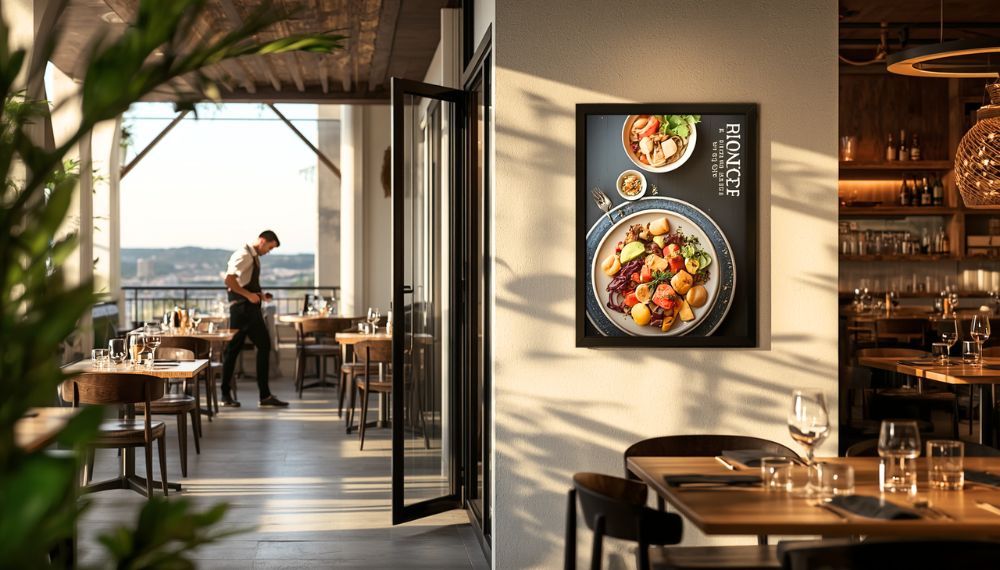
Customers Judge Before They Taste
In a restaurant, the customer's decision-making doesn’t start only when the food arrives.
It starts with the facade, the entrance, the atmosphere, the service, and also the menu.
The menu communicates price, quality, organisation, style, and trust. When it’s scribbled on, laminated for too long, poorly photographed, or full of manual changes, it sends a message the restaurant might not want to convey.
Even if the food is excellent, perception can be affected.
An Outdated Menu Creates Friction
Printed menus still make sense in many settings. The issue isn’t the paper itself.
The problem arises when the menu no longer reflects the restaurant’s actual operation.
This happens when:
- sold-out dishes remain visible;
- prices have changed but are not updated correctly;
- daily menus are communicated in an improvised way;
- seasonal campaigns take too long to update;
- photos no longer represent the dishes well;
- customers have to ask the staff too many questions.
Every small friction reduces clarity and increases effort.
Digital Menus Are More Than Just 'Screens with Food'
A digital menu shouldn’t be seen merely as a modern version of the paper menu.
When well designed, it helps the restaurant communicate what it wants to sell at any given moment more effectively.
It can highlight:
- daily specials;
- lunch menus;
- chef’s recommendations;
- temporary campaigns;
- drinks;
- desserts;
- seasonal menus;
- high-margin products;
- information in different languages.
The advantage lies in flexibility. The restaurant can update content without reprinting, without sticking new sheets, and without relying on makeshift solutions.
The Mistake Is Trying to Show Everything at Once
One of the most common mistakes in digital menus is trying to cram too much information onto the screen.
If customers see too many dishes, prices, images, and texts simultaneously, the message loses impact.
The goal of a screen shouldn’t be to show everything but to highlight what’s most important.
A good digital menu should have:
- clear visual hierarchy;
- minimal text per screen;
- high-quality images;
- appropriate contrast;
- clear pricing;
- quick readability;
- frequent updates.
The screen should help customers decide, not force them to decipher.
The Menu Can Also Boost Sales
A digital menu can be a powerful sales tool.
Unlike a static printed menu, it allows communication to be tailored to the time of day, season, stock levels, or the restaurant’s strategy.
For example:
- highlight quick lunch menus at midday;
- promote drinks or snacks in the late afternoon;
- feature main courses at dinner;
- communicate campaigns on specific days;
- switch languages in tourist areas;
- show special menus during events.
This doesn’t replace food quality but enhances how the offer is presented.
When It Makes Sense to Invest
A digital menu makes sense when the restaurant frequently changes content or wants to improve visual communication on-site.
It’s especially useful in:
- restaurants with daily menus;
- cafés and bakeries;
- pastry shops;
- hotels with restaurants;
- venues with counters;
- food courts;
- restaurants in tourist areas;
- businesses with seasonal campaigns.
It can also be worthwhile when a venue wants to project a more modern, organised, and professional image.
CMS Is Part of the Decision
The screen is important, but content management is just as crucial.
If updating the menu is difficult, the system becomes impractical.
So before choosing a solution, the restaurant should ask:
- who will update the content?
- how often?
- is it possible to schedule menus?
- is it easy to swap images?
- can future campaigns be prepared?
- can the team use it independently without always relying on third parties?
A digital menu only has value if it’s easy to keep updated.
Conclusion
Printed menus haven’t disappeared, nor do they need to.
But in many restaurants, they no longer suffice as the main communication tool.
When the menu looks old, confusing, or hard to update, it can harm the venue’s perception. A well-designed digital menu helps make the offer clearer, more visual, and adaptable to the restaurant’s daily rhythm.